


Joy Match 3D
Ino Labs
Joy Match 3D is the kind of casual game I open when I want something clear, quiet, and easy to understand within seconds. The basic task is simple: find three matching three-dimensional objects and pair them before the available space becomes a problem. That simplicity is exactly why it works for short breaks, although the later challenge comes less from learning complicated rules and more from staying organized under pressure.
Developed by Ino Labs, the game is free to start and aimed at Everyone. It belongs to the casual puzzle category, but it feels more tactile than a traditional tile-matching game because the objects are presented as small 3D pieces rather than flat symbols. I found that difference important. Instead of scanning rows from left to right, I have to look around a crowded arrangement, notice partially hidden items, and decide which match is safe to remove first.
The store summary calls it a match-triple 3D game, while the short description presents it as Joy Match 3D. Those labels are brief, but they capture the central appeal: this is a visual sorting game with a gentle beginning and a steadily more demanding need for planning. It is not a story-driven experience or a deep strategy title. Its value is in the repeated little decisions that make a few spare minutes feel pleasantly occupied.
How a normal session actually feels
The baseline workflow is easy to learn
My usual session starts with a quick scan rather than immediate tapping. I look for an obvious group of three, then check whether selecting those objects will expose something useful underneath. That second glance matters. A match may be available now, but removing it can also reveal a better route through the board. Treating every visible triple as equally valuable is one of the fastest ways to fill the holding area with awkward leftovers.
The game rewards a simple repeatable rhythm: identify a possible group, trace where the other pieces are, select only when I understand the short-term consequence, and then scan again. This makes it more engaging than a purely reflex-based matching game. The objects are familiar enough to recognize quickly, but the 3D presentation can make a piece look available when another item is still blocking it.
Related News

Threads in Real Life: Who Should Join, Lurk, or Leave

How SHEIN Turned Shopping Into an Endless Content Feed

How to Make Fortnite Feel Smarter on Mobile

Should You Switch to Microsoft Outlook on Mobile?

Why Gallery Keeps Pulling Users Back

X Review: Why Its Network Still Matters
For a commuter or someone waiting for an appointment, that workflow is convenient because there is almost no learning barrier. I do not need to remember a complicated control scheme, build a character, or follow a long chain of instructions. I can start with the visual problem in front of me. At the same time, the game is not completely mindless once the board becomes crowded. The challenge comes from controlling the order of removal.
A realistic everyday use case is a short evening break when I want something more active than scrolling but less demanding than a competitive game. One or two rounds give me a contained task with a clear objective. I would not choose it when I want a long narrative session, a social match, or a game that lets me experiment with a large strategic system. Its strength is precisely that it stays focused.
What I check before making the first match
I have found it useful to separate pieces into three groups: immediately visible triples, pairs that need one more item, and objects whose position is unclear because the 3D arrangement hides part of them. I begin with the first group only when the match does not consume a valuable space needed for a harder pair. This habit sounds minor, but it reduces the number of forced moves later.
Gallery
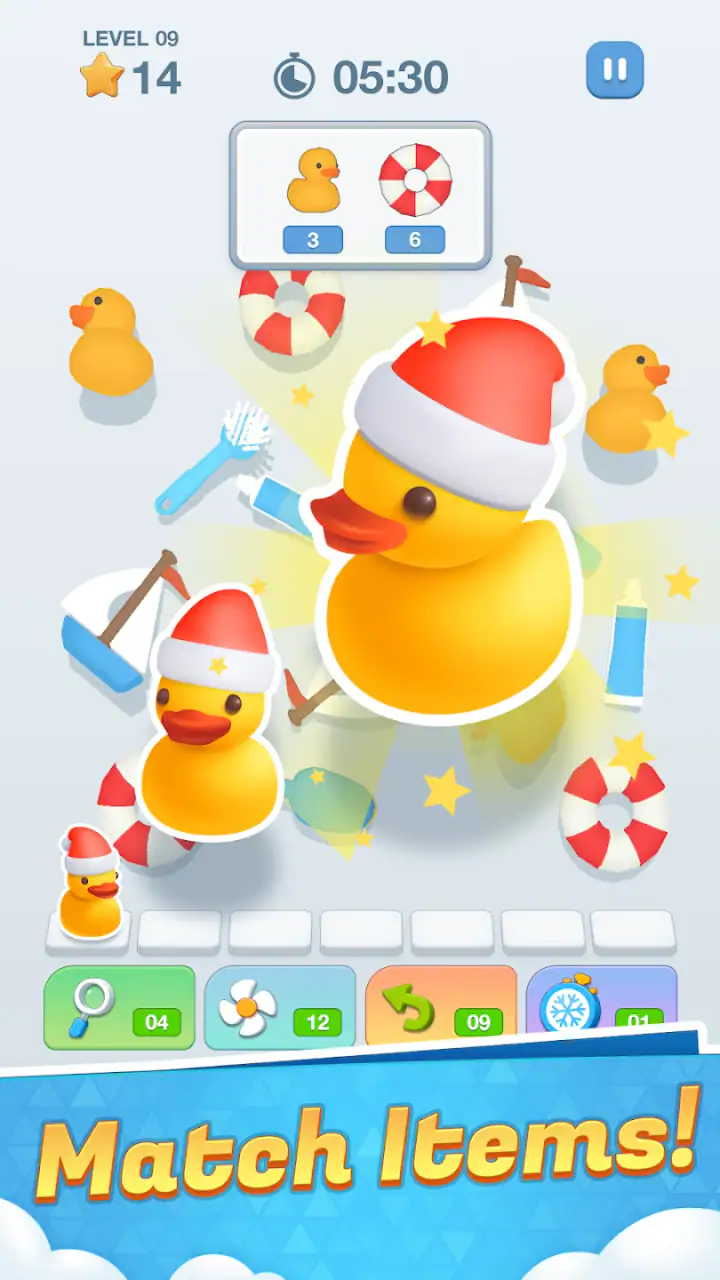
Another helpful habit is to remember where a pair was seen instead of repeatedly tapping around the board. Rechecking the same area wastes attention and can lead to accidental selections. I mentally mark the object type and its rough location, then search for the third piece. This is particularly helpful when several objects have similar colors or shapes.
The most useful question is not “What can I match?” but “Which match gives me the most information?” Removing a group that uncovers several new objects can be better than clearing a group that leaves the rest of the board unchanged. I use that principle whenever the board offers several apparently safe choices.
Settings worth checking before settling in
I recommend opening the available settings before playing seriously, even if the default presentation seems fine. In a 3D matching game, sound and visual comfort can affect how long a session feels. I usually decide whether I want audio on based on where I am playing, and I check whether the interface offers a way to adjust the experience to suit a quieter environment. I would rather make that choice at the start than interrupt a difficult round later.
It is also worth checking how the game presents interruptions, assistance, and purchase prompts during play. I do not treat every offered aid as automatically useful. A hint can save a round, but using help too early removes the part of the game I enjoy most: finding the cleanest route myself. I prefer to reserve assistance for a board where I have genuinely lost track of the available pieces.
The current version is 34.2.4, and the game requires Android 8.0 or later. That makes compatibility a practical consideration before installation, especially on an older phone or tablet. On a supported device, I still pay attention to screen size. A larger display can make the 3D layout easier to inspect, while a small screen may require more careful camera or board interaction if the view becomes busy.
The game is free to download and play, but it includes optional in-app purchases ranging from $0.99 to $99.99 per item. I see that as a reason to decide on a personal spending boundary before handing the phone to a child, even though the content rating is Everyone. The game can be enjoyed without treating purchases as part of the basic routine, but the presence of optional items is still something families should keep in mind.
Faster patterns that improve consistency
Speed does not come from tapping everything quickly. It comes from reducing unnecessary decisions. I first search for a complete triple, then for a pair with a clear third item, and only afterward consider moves that depend on uncovering hidden pieces. This priority order keeps my holding spaces from filling with random objects.
I also avoid collecting a pair just because it is convenient. A pair can become a liability if the third item is buried under several layers. When I take two matching pieces, I want a reasonable idea of how the final piece will become available. If I cannot see that path, I usually choose a different group and use the next move to reveal more of the board.
One non-obvious improvement is to use the board’s visual clutter as information. A crowded region often contains the pieces that control the next stage of the puzzle. Instead of clearing only the easiest objects around the edges, I look for a move that opens a central or obstructed area without creating too many unmatched pieces. This turns the board from a collection of objects into a sequence of access points.
I find that pausing for a brief scan after every completed triple is more effective than trying to plan a long chain in advance. The layout changes as pieces disappear, so an old plan can become irrelevant. A short reset prevents tunnel vision and makes it easier to notice a newly exposed match.
For players who like repeatable routines, I suggest using the same decision checklist every round:
- Find complete triples that do not block a more important route.
- Locate the third item before committing to a pair.
- Prefer moves that reveal several new possibilities.
- Keep the holding area varied rather than filling it with uncertain pairs.
- Pause and rescan after each successful removal.
This is not a secret trick or an exploit. It is simply a way to make the visual puzzle less impulsive. The game remains approachable, but experienced play becomes noticeably calmer when each tap has a reason.
Where the advanced challenge comes from
The deeper limit is attention. Because the objects are three-dimensional, I sometimes recognize a familiar item without immediately understanding whether it is selectable, partially covered, or positioned behind another piece. That creates a small but meaningful difference from flat match-three games, where the whole board is usually visible at once.
There is also a trade-off between clearing quickly and preserving flexibility. A fast match feels satisfying, but a board can become harder if the remaining pieces form several incomplete groups. I have lost rounds not because I lacked a possible match, but because I used the available spaces poorly. The game therefore rewards restraint as much as recognition.
When I get stuck, I do not immediately restart. I first identify which pieces are consuming space and whether one of them can be completed soon. If a pair has no visible route to its third member, it becomes a priority to resolve or avoid. This way of diagnosing the board is more useful than randomly searching for another match.
Hints and other forms of assistance, where available in the play flow, should be treated as recovery tools rather than part of the standard strategy. Using them on every difficult moment can make progress feel less earned and may encourage a dependence on prompts. I prefer to use help only after a deliberate scan, especially when the problem is visual confusion rather than a lack of possible moves.
The game is less suitable for people who need a fully predictable puzzle with no visual ambiguity. It is also not the best choice for someone looking for multiplayer competition, character progression, or a narrative reason to keep playing. Compared with a conventional flat match-three title, this one asks more from spatial inspection and less from planning long chains or managing special abilities. Compared with a hidden-object game, it offers clearer rules but less emphasis on story and scene discovery.
Who will enjoy it most
I would recommend it to players who like tidy visual tasks, short repeatable rounds, and a gentle learning curve that still leaves room for better habits. It is especially comfortable for casual players who do not want to study a tutorial before beginning. The Everyone rating also makes it approachable for a broad audience, although purchase controls remain sensible for shared devices.
It can work well as a small focus exercise. When I have been switching between tasks and want to reset my attention, searching for triples gives me a narrow problem to solve. The benefit is modest but real: the game asks me to observe, remember locations, and choose an order instead of simply reacting to animation.
I would skip it if I become frustrated by repeating similar puzzle structures or if I need a game with substantial variety between sessions. The basic loop is intentionally consistent. That consistency is comforting for some players and limiting for others. Anyone expecting a large collection of radically different modes may find the experience too focused.
What the rating and audience suggest
The game holds a 4.7 average from around 8.4 thousand ratings, with roughly 1.9 thousand written reviews, and it has passed 500 thousand installs. Those figures suggest that the straightforward format has found a substantial audience, but they should not replace personal judgment. A popular casual game can still be the wrong fit if its pace, visual style, or purchase options do not match your preferences.
For me, the strongest evidence of quality is how quickly the basic loop becomes comfortable without becoming entirely automatic. I can play casually, but careful selection still matters when the board becomes crowded. That balance is more valuable than a long feature list for this type of game.
My mastery verdict
Joy Match 3D succeeds because it turns a very simple matching idea into a small spatial-management exercise. I enjoy it most when I slow down enough to plan the next two or three useful discoveries rather than chase the first available triple. Settings are worth checking for comfort, purchases are worth treating deliberately, and the best shortcut is a consistent scanning routine rather than frantic tapping.
In my experience, it is a strong free casual option for short breaks and relaxed concentration. It does not replace a deeper puzzle game, a competitive match, or a story adventure, and its repeated format will not suit everyone. But if you like organizing visual clutter, making careful choices, and improving through small repeatable habits, this is an easy game to keep installed. The real skill is not matching faster; it is protecting your future moves.
FAQs for Joy Match 3D
What is Joy Match 3D and how do you play it?
Joy Match 3D is a casual puzzle game built around matching identical 3D objects. You search through a colorful collection of items, select matching pieces, and place them into pairs or sets before the available slots fill up. The controls are simple and work well on a touchscreen, while progressively harder levels add more objects, visual clutter, and time or movement pressure.
Is Joy Match 3D free to download and play?
Joy Match 3D can generally be downloaded and played for free, but the experience may include optional in-app purchases. These purchases can provide coins, boosters, extra chances, or other helpful resources. The game may also use advertising, particularly between levels or when you choose a reward. Players who prefer not to spend money should review the store listing and purchase settings before playing.
Does Joy Match 3D require an internet connection?
Many of the basic matching levels may be playable without a constant internet connection, which is convenient when traveling or using limited mobile data. However, certain features can depend on online access, including advertisements, cloud synchronization, events, leaderboards, and in-app purchases. Offline availability may also vary after updates, so it is best to test the game before relying on it without Wi-Fi.
Is Joy Match 3D suitable for children?
Joy Match 3D uses accessible controls, bright visuals, and straightforward matching mechanics, making it easy for many children and casual players to understand. Nevertheless, parents should check the recommended age rating and review the advertising and in-app purchase policies. Because the game may encourage repeated play or optional spending, parental controls are advisable when the application is installed on a child’s device.
What are the main advantages and disadvantages of Joy Match 3D?
The main advantages of Joy Match 3D are its easy-to-learn gameplay, attractive 3D objects, short levels, and relaxing yet increasingly challenging puzzle format. It can be a good choice for quick sessions or players who enjoy sorting and observation games. Possible disadvantages include advertisements, limited lives or boosters, repetitive matching after extended play, and pressure to purchase resources when a difficult level becomes frustrating.
Pros
- Simple drag-and-match gameplay is easy to learn.
- Bright 3D objects make the board visually appealing.
- Short levels work well for quick gaming sessions.
- Increasing difficulty keeps the puzzles engaging.
- Offline play is convenient when you have no connection.
Cons
- Frequent ads may interrupt gameplay between levels.
- Some levels can feel repetitive after extended play.
- Later puzzles may rely more on patience than strategy.
- Limited variety in objectives can reduce long-term appeal.
- Optional purchases may be needed to progress more comfortably.


